


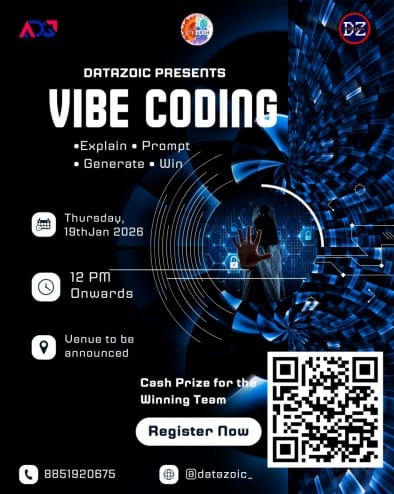
“Vibe Coding” – Explain, Prompt, Generate!
Organized By: Datazoic, official departmental society of Artificial Intelligence & Data Science
Date & Time: 19th February 2026, 11:30 – 2:30 pm
1. Introduction
The Department of Artificial Intelligence & Data Science (AI&DS), through its official departmental society Datazoic, successfully organized “Vibe Coding,” an innovative technical event that blended logical reasoning with artificial intelligence.
The event was designed to explore a modern dimension of coding where problem understanding, communication clarity, and prompt engineering play a crucial role. Unlike traditional coding competitions that focus primarily on manual coding speed, this event emphasized effective collaboration with AI tools.
Participants competed in teams of two, engaging in a structured format where one member interpreted and explained a problem in simple language, while the other crafted a precise AI prompt to generate a solution. The event aimed to highlight the importance of clarity of thought and strategic AI usage in today’s evolving technological landscape.
2. Objectives of the Event
The primary objectives of the “Vibe Coding” were:
- To promote logical problem understanding and analytical thinking among students.
- To introduce participants to the concept of prompt engineering and AI-assisted development.
- To enhance communication skills by requiring clear and structured explanation of technical problems.
- To demonstrate the practical integration of artificial intelligence in problem-solving.
3. About “Vibe Coding”
“Vibe Coding” was a team-based coding challenge where participants worked in pairs with clearly defined roles.
Each team consisted of:
- Explainer: Responsible for understanding the given problem and explaining it in simple, non-technical language.
- Prompter: Responsible for converting the explanation into a structured AI prompt to generate a complete solution.
Manual editing of the AI-generated code was not permitted. The generated solution was submitted for evaluation and assessed on the basis of correctness, efficiency, time management, and quality of prompting.
The event created a competitive yet intellectually stimulating environment where strategic thinking and clarity were as important as technical knowledge.
4. Summary of the Event
4.1 Briefing and Commencement
The event commenced with a formal briefing by the organizing team. Participants were informed about the rules, role division, evaluation criteria, and restrictions.
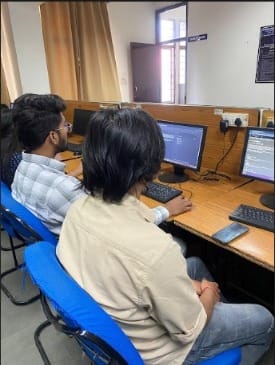
Teams were provided with a problem statement and given a fixed time duration to complete the task. The Explainer first analyzed the problem and conveyed the logic in simplified terms to the Prompter. The Prompter then interacted with an AI tool to generate the required solution.
The atmosphere was energetic and engaging, with teams actively discussing, strategizing, and refining their explanations to achieve optimal results.
4.2 The Judging Process
The judging panel, comprising faculty members and student coordinators, evaluated the submissions carefully.
The assessment criteria included:
- Correctness of the solution
- Time taken to complete the task
- Quality and clarity of the AI prompt
- Efficiency and structure of the generated code
The competition showcased impressive coordination between teammates and highlighted how effectively AI can be leveraged when guided with clarity and precision.
4.3 Conclusion and Felicitation
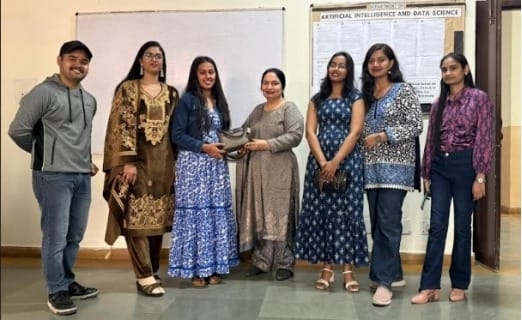
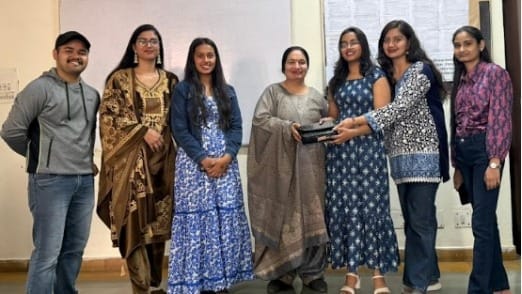
After thorough evaluation, the winning team was announced based on overall performance and adherence to the rules. The winners were felicitated and congratulated for their strategic thinking and excellent teamwork.
All participants were appreciated for embracing the concept of AI-integrated problem solving and demonstrating enthusiasm throughout the event.
The event concluded successfully, leaving participants with a deeper understanding of collaborative intelligence between humans and AI systems.
5. Key Takeaways for participants
- Prompt Engineering Skills: Participants learned the importance of structuring precise and unambiguous prompts.
- AI Collaboration: Gained practical exposure to AI-assisted coding workflows.
- Communication Clarity: Improved ability to explain technical concepts in simple language.
- Team Coordination: Strengthened collaborative problem-solving skills.
Strategic Thinking: Understood that effective reasoning is as critical as writing code