



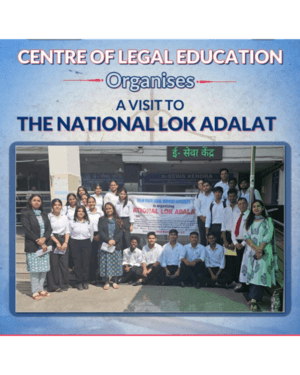
On 13 September 2025, a group of 22 first-year students from the BA LL.B (H) and BBA LL.B (H) programmes of the Centre of Legal Education, Dr. Akhilesh Das Gupta Institute of Professional Studies (ADGIPS) visited Karkardooma Court to observe the functioning of a Lok Adalat. The visit began at 10:00 A.M. and was organized under the guidance of Ms. Kajal, Assistant Professor, CLE, and Ms. Pronika Singh, Assistant Professor, CLE, along with Dr. Chandrika Setu Sharma, Associate Professor and Head of the Department, CLE. The primary objective of the visit was to provide students with practical exposure to the functioning of the judicial system and to help them understand the concept and importance of Lok Adalat as a significant mechanism of Alternative Dispute Resolution (ADR).
During the visit, students observed several cases being settled in the Lok Adalat. These cases mainly included motor vehicle accident compensation claims, matrimonial disputes, property disputes, compoundable criminal cases, and recovery disputes. The students noted that the proceedings in the Lok Adalat were comparatively informal when compared to regular court proceedings. The focus of the forum was on amicable settlement, where both parties were encouraged to reach a mutual agreement instead of engaging in prolonged litigation. The presiding judge and panel members played a crucial role in facilitating discussions between the parties and ensuring that the settlement was fair and acceptable to both sides.
After the proceedings concluded, the students were given an opportunity to interact with Divyam Lila, who warmly welcomed them and shared valuable insights about the importance of ADR mechanisms in the Indian legal system. During the interaction, the judge discussed how Lok Adalats help in resolving disputes efficiently and reduce the burden on the formal judicial system. The benefits of Lok Adalats in terms of saving time, reducing litigation costs, and improving accessibility to justice were also highlighted. The judge further explained the types of cases that can be referred to Lok Adalat and emphasized the importance of mutual consent between the parties for settlement.
The discussion also included insights into the role of the Legal Services Authorities Act, which empowers citizens, particularly those from economically weaker sections, by providing free legal aid and access to justice. The judge encouraged the students to actively promote ADR mechanisms in their future legal careers and emphasized the importance of developing strong negotiation and mediation skills, as these skills are becoming increasingly relevant in the contemporary legal landscape. The session concluded with an interactive question-and-answer discussion in which the students clarified their doubts and gained deeper understanding of the functioning of Lok Adalats.
Overall, the visit to the Lok Adalat at Karkardooma Court proved to be a valuable experiential learning opportunity for the participating students. It provided them with practical exposure to real-life dispute resolution, helped them connect theoretical legal knowledge with practical application, and inspired them to appreciate the role of ADR mechanisms in delivering efficient and accessible justice. The activity benefited the first-year students of BA LL.B (H) and BBA LL.B (H) and contributed significantly to their practical understanding of the legal system.